

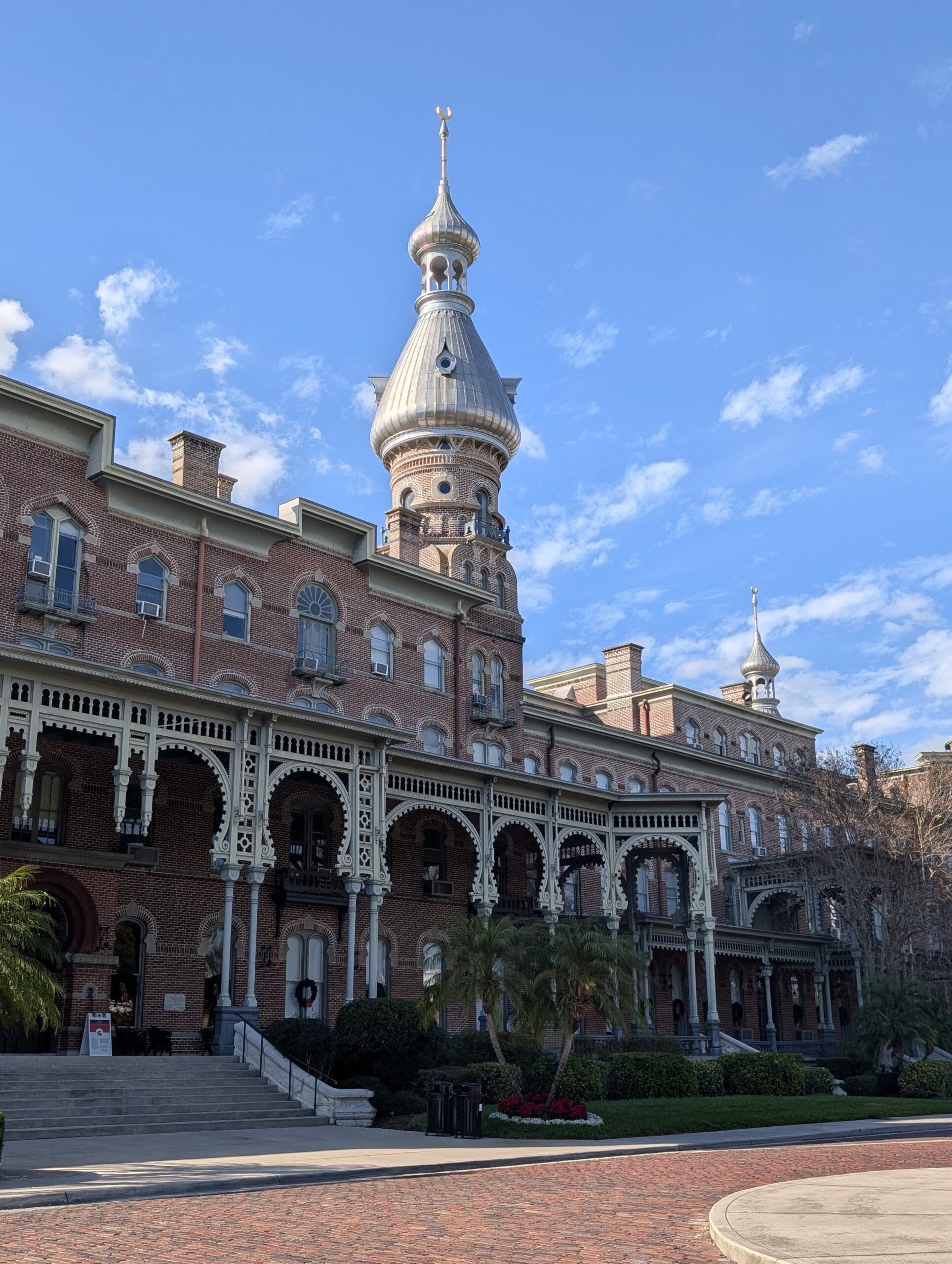
On the west bank of the Hillsborough River, piercing the sub-tropical skyline of Tampa, Florida, stand 13 gleaming, silver, Moorish minarets. They seem, at first glance, like a mirage, an improbable fragment of ancient Granada dropped into the heart of a modern American city. These fantastical spires do not belong to a mosque; they are the crown of Plant Hall, the centerpiece of the University of Tampa, which was, in its original incarnation, the Tampa Bay Hotel.
The Tampa Bay Hotel, built by railroad and shipping magnate Henry Bradley Plant and opened in 1891, was not merely a place of lodging; it was a phenomenon, an audacious statement of Gilded Age wealth, ambition, and technological wonder. It was Plant’s personal masterpiece, his way of signaling to the world that Florida’s wild, untapped west coast was open for business, luxury, and history. The story of this building is more than an architectural chronicle; it is the story of Tampa’s transformation and its intricate role in a pivotal moment of American imperialism.
The Gilded Visionary: Henry Plant’s “Southern Empire”
To understand the hotel, one must first understand the man. Henry Bradley Plant (1819–1899) was a contemporary of industrial titans like Vanderbilt, Rockefeller, and Carnegie, and, most relevantly, his rival on Florida’s east coast, Henry Flagler. Plant made his fortune by astutely consolidating and expanding southern railway lines. What became the “Plant System” was a vast, integrated network of railroads, steamships, and, crucially, a series of resort hotels that connected the cold, industrialized north to the perceived exotic paradise of the deep south.
Flagler saw the potential of Florida’s Atlantic coast, building the legendary Hotel Ponce de Leon in St. Augustine and pushing his tracks south to Palm Beach and Miami. Plant, a man who Success magazine later dubbed the “King of Florida,” focused his gaze on the Gulf coast. In the late 1880s, Tampa was little more than a dusty, isolated town of a few thousand residents, dominated by the decaying Fort Brooke military outpost. Its main, budding industry was cigar manufacturing, imported from Key West by Vicente Martinez Ybor.
For Plant, Ybor’s new settlement provided an industrial anchor, but his true vision was to create a terminal for his empire and a luxurious terminus for the wealthy winter tourists he intended to ferry down on his “Orange Belt Railway” and “Plant Steamship Line” (which sailed as far as Havana, Cuba). He decided that this remote outpost deserved nothing less than a palace. Legend has it he even sent a famously prickly telegram to Flagler regarding their respective projects: “Your hotel is a gem. Mine will be a setting for a gem.”
Building a Palace of “Oriental” Splendor
When Plant approached his investors for his Tampa project, they balked, seeing the idea of a massive luxury resort in such a primitive location as a monumental folly. Undeterred, and with his characteristically absolute confidence, Plant decided to fully fund the project himself. The construction, which began in 1888, was a gargantuan undertaking. At its peak, thousands of laborers were employed.
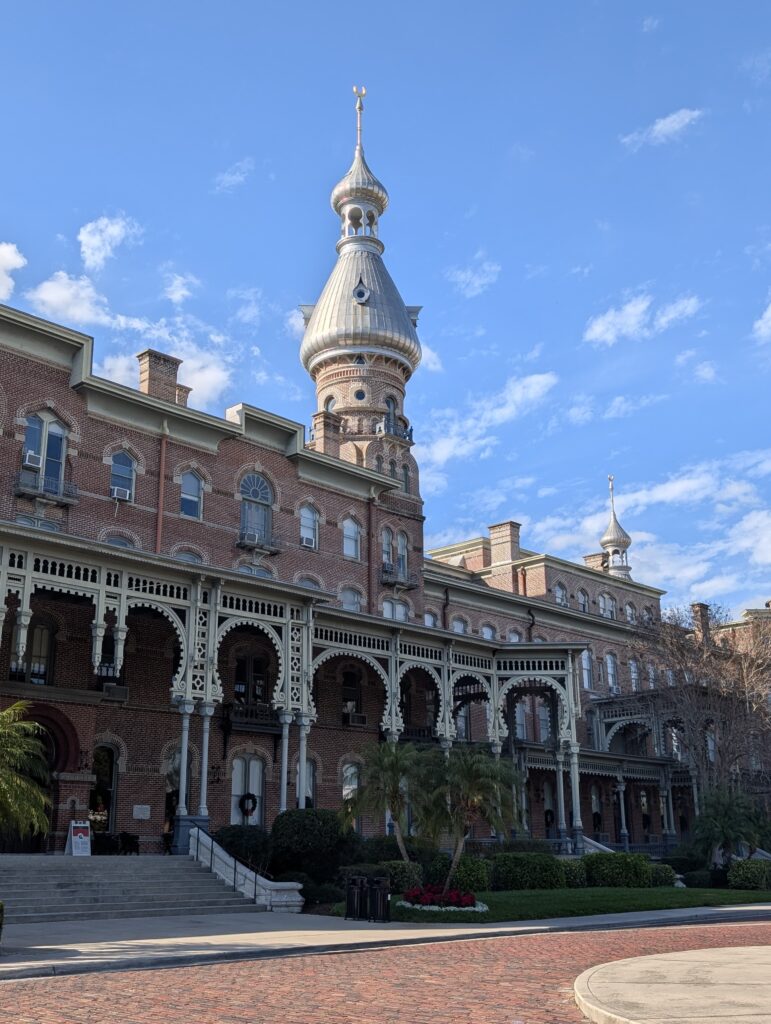
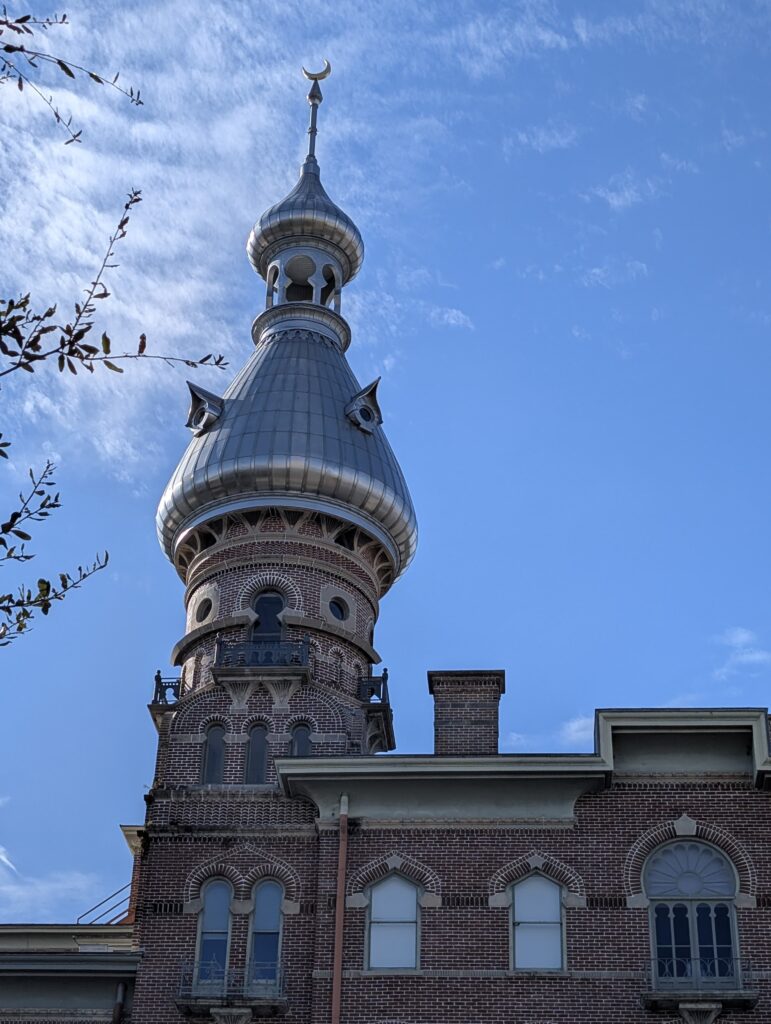
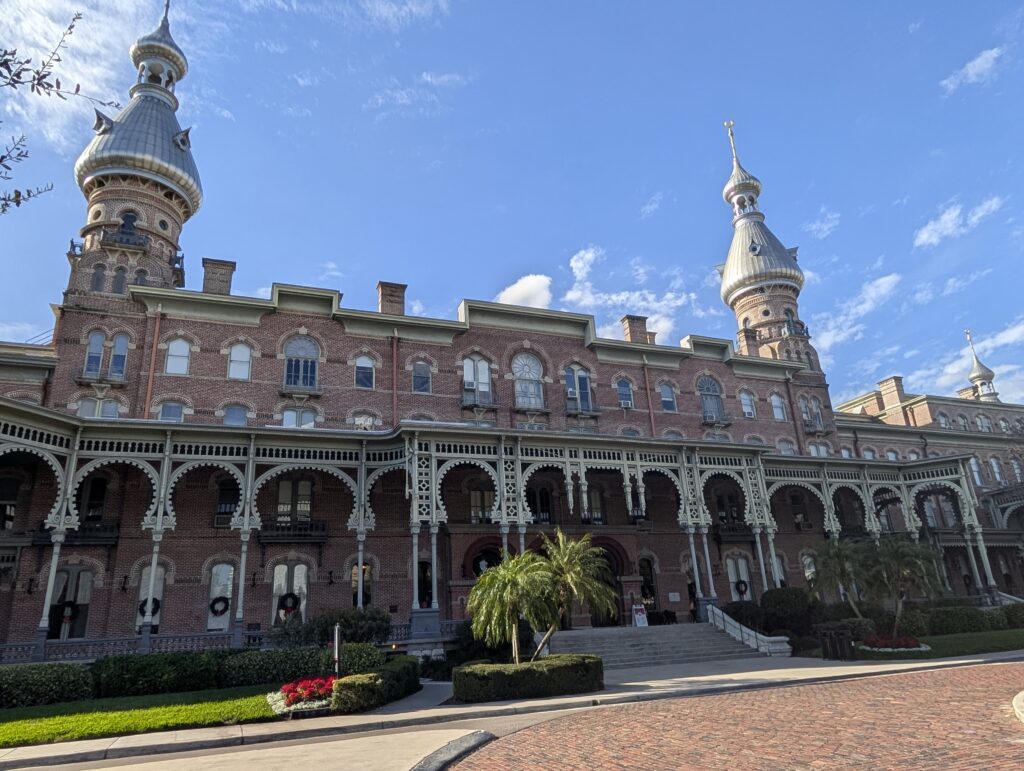
For the design, Plant selected architect J.A. Wood, who had experience with large-scale projects and shared Plant’s penchant for the theatrical. They did not opt for the popular Victorian Gothic or Queen Anne styles of the day. Instead, they embraced the Moorish Revival style, an architectural movement inspired by the Alhambra palace in Granada, Spain. Plant felt this style, with its exotic arches, intricate lattice-work (“gingerbread”), and fantastical domes and minarets, captured the essence of the “Orientalist” fantasy that Victorians, yearning for escape and adventure, craved.
The final cost of the building alone was an astonishing $2.5 million (well over $75 million today), but the extravagance did not stop there. Plant and his wife, Margaret, traveled the world, particularly Europe and Asia, on multi-year shopping trips to furnish their creation. They spent another half a million dollars on original paintings, furniture, Venetian mirrors, porcelain, exotic tapestries, and sculptures. A special train line was built to the construction site simply to deliver these artifacts. One contemporary account described the arrival of “art by the trainload.”
Florida’s “First Magic Kingdom”: Innovation and Opulence
When the Tampa Bay Hotel officially opened on February 5, 1891, with a grand, 2,000-guest masquerade ball, the results of this immense investment were staggering. The building was an architectural oddity, a quarter-mile long, five stories high, and spanning six acres, all punctuated by those 13 minarets. Its facade combined the Moorish elements with more traditional red brick and Victorian wood trim, creating a bizarre but unforgettable hybrid.
More surprising than its appearance, however, were its internal wonders. It was, for its time, perhaps the most advanced building in Florida. While most of the state was still reliant on gaslight and outhouses, the Tampa Bay Hotel boasted:
- Electric Lighting: All 511 rooms and suites were equipped with incandescent electric lights, making it the first building in Florida with full electric lighting.
- Telephones: Every room had a telephone, allowing guests to communicate with the front desk and each other—an unheard-of luxury.
- The State’s First Elevator: It was home to the first-ever elevator installed in Florida. A functional relic of this machine is still operational today, one of the oldest such elevators in the United States.
- Indoor Plumbing and Private Baths: Most of the hotel’s accommodations featured their own private bathrooms, a defining standard of true luxury in the era.
This technological superiority, combined with the fantastical architecture and museum-quality furnishings, led many to refer to it as “Florida’s First Magic Kingdom.” To Plant, the hotel was not necessarily designed to be a direct profit-maker (he is said to have never turned a profit on its operation). Its primary function was as a massive advertisement for his transportation system, a spectacular destination that would make people want to ride his trains.
The hotel offered a complete, self-contained world of Gilded Age leisure. On its sprawling grounds, which extended to the water’s edge, guests could enjoy tennis courts, an indoor swimming pool (which later became the University’s gymnasium), extensive botanical gardens, a boat house, a large performing arts casino (which served as a theater, not a gambling den), and a vast dining room that could seat 500.
The Historic Significance: General Shafter’s Rocking Chair War
The Tampa Bay Hotel was a Gilded Age icon, hosting an array of the era’s celebrities, including Thomas Edison, Babe Ruth (who later signed his first professional contract there and hit one of his longest home runs on the neighboring athletic field), Booker T. Washington, and Sir Winston Churchill.
However, its single greatest moment of historic significance arrived in 1898. Upon the outbreak of the Spanish-American War, the U.S. government selected Tampa as the primary point of embarkation for American forces heading to Cuba. Henry Plant, ever the shrewd lobbyist, had pushed hard for this. His port was ideal, and his vast hotel was the only facility in the region capable of housing the military’s leadership.
Overnight, the leisure-filled Moorish palace was transformed into a bustling military command post. Generals, including the rotund William R. Shafter, established their headquarters within the hotel. Its vast, expansive veranda, filled with rocking chairs, became the setting where invasion strategies were debated and commands from Washington were received. This surreal imagery of high-ranking officers in uniforms and white linen suits plotting battle while surrounded by original Venetian mirrors and Oriental rugs led to the phrase the “Rocking Chair War.”
Among the military figures stationed at the hotel was Colonel Theodore Roosevelt. His famous “Rough Riders” volunteer cavalry regiment encamped on the surrounding acreage and athletic fields, awaiting the chaotic, delayed departure that would eventually make them legends at the Battle of San Juan Hill. Notable figures like Clara Barton, founder of the American Red Cross, and numerous war correspondents, also stayed at the hotel. For a brief, intense summer, the fate of the Spanish Empire and the rise of the United States as a global power were linked to the decisions made in this Florida hotel.
Decline, Transition, and a Bold New Purpose
Following Henry Plant’s death in 1899, the “Plant System” was dissolved and its assets sold, though the city of Tampa maintained the hotel’s operation. The property, however, struggled to remain profitable as tourism patterns changed and the Great Depression took its toll.
In 1930, after 40 years of service, the grand Tampa Bay Hotel closed its doors for the last time as a public resort. For several years, its future was uncertain, and the glorious building was in danger of falling into disrepair or even being razed.
It was during this low point that a truly forward-thinking decision was made. In 1933, the freshly established Tampa Bay Junior College was granted permission to move into the former hotel, utilizing the original suites and rooms as classrooms, laboratories, and offices. This inspired repurposing saved the building, and as the college grew and thrived, it evolved into the University of Tampa (UT), ensuring the structure would have a lasting and vital purpose.
The Hotel Today: Living History
Today, Plant Hall, as it is now called, is the definitive architectural and spiritual center of the University of Tampa campus. Walking its ornate, curved corridors, it is still possible to imagine its former life. The original grand dining hall serves as the main registration and administrative hub. Students attend lectures in rooms that once hosted Victorian royalty and Gilded Age titans.
The building is now a designated National Historic Landmark, recognized not just for its unique architecture but also for its critical role in the Spanish-American War. A massive effort has been undertaken to continually restore and preserve the structure, from the meticulously cleaned stainless-steel finish of the minarets to the structural reinforcement of the massive performance spaces.
The true legacy of the Tampa Bay Hotel, however, is expertly curated and preserved within the Henry B. Plant Museum, which occupies the entire south wing of the building’s first floor. Founded by the city in 1933, the same year the college moved in, the museum operates as a separate entity dedicated to preserving the history of the hotel and the experiences of its diverse individuals.
The museum is a masterful example of the Historic House Museum style. Unlike most such institutions, which display replicas, the Plant Museum contains the actual original furnishings, artwork, and artifacts that Henry and Margaret Plant collected and that graced the hotel. Entering the museum is a genuine act of time travel. The “Reading and Writing Room,” in particular, is preserved so authentically that it is said to look exactly as it did in 1898, allowing visitors to stand where Theodore Roosevelt’s wife, Edith, may have written letters while her husband awaited deployment.
The museum also features other authentic “lifestyle vignettes” including:
- A “Turkish Corner” (or Ottoman Parlor), a popular Victorian space for relaxing.
- The Original Dining Room, set with Plant’s personal china and silver.
- Displays on Gilded Age leisure, featuring original swimsuits and golf equipment.
- Exhibits on the Spanish-American War, offering an unprecedented look at how the hotel and the surrounding city functioned as a mobilization point.
Regular programs like “Upstairs/Downstairs,” where live performers portray actual staff members or guests, further immerse visitors in the world Plant built.
Henry B. Plant did not just build a hotel; he built a portal. With its Moorish Revival spires and technological wonders, the Tampa Bay Hotel was a physical manifestation of a man’s belief in the impossible and a society’s fascination with the exotic. It stood as a beacon, announcing Tampa’s arrival and demonstrating that Florida’s true potential was as a destination for the mind and the spirit, not just a source of raw materials.
While its days as a luxury resort are long gone, its resurrection as Plant Hall and the creation of the Henry B. Plant Museum ensure that its history is active and relevant. The building serves as an anchor for a world-class university, and its museum provides an irreplaceable lens into the opulence, innovation, and imperialism of America’s transformative Gilded Age. In a world of rapidly changing skylines, Plant’s Moorish palace remains, as it was meant to be, the fantastical, historically significant heart of Tampa.

